MR

> whoami

Mischa
Rauch

Data scientist and engineer for AI and automation

I build software that takes recurring work off a company's hands. From research all the way into daily operations.

Mischa Rauch

At Rauch Digital I own engineering, IT and automation.

Co-founder

A marketing agency runs on things that repeat: launching campaigns, collecting applications, getting them approved, invoicing, finding what someone wrote down two years ago. I turned that into a platform that handles the repetition and leaves the team with the decisions.

  • 38ad accounts

    connected through the Meta API. A campaign is built from client data, not from clicking through Ads Manager.

  • 3,115documents

    searchable through a hybrid of vector and full text search. Before that, the company's knowledge sat in folders nobody opened.

  • 18 stest run

    for 1,544 tests, down from 30 minutes against a cloud database. The suite now runs before every deploy instead of once a week.

Four systems that run every day

Built at Rauch Digital, used by the team and by clients. Not a prototype among them.

  1. 01

    The agency platform

    From client request to invoice

    The situation

    A campaign passed through eight tools: request form, spreadsheet, Trello, Google Drive, Ads Manager, applicant tracking, accounting. Between every step sat a person carrying data from one place to the next.

    What I built

    One platform a campaign moves through, from the request to the invoice. Copy and creatives are generated from the client interview, the approval page builds itself from those, and once the client signs off, both the campaign in the ad account and the recurring invoice are created.

    What follows from it
    • Request, approval, launch and billing in one place instead of eight tools
    • Campaigns are created in the ad account through the API, always paused, never live
    • A nightly run reconciles the state at Meta and Google and carries the billing forward
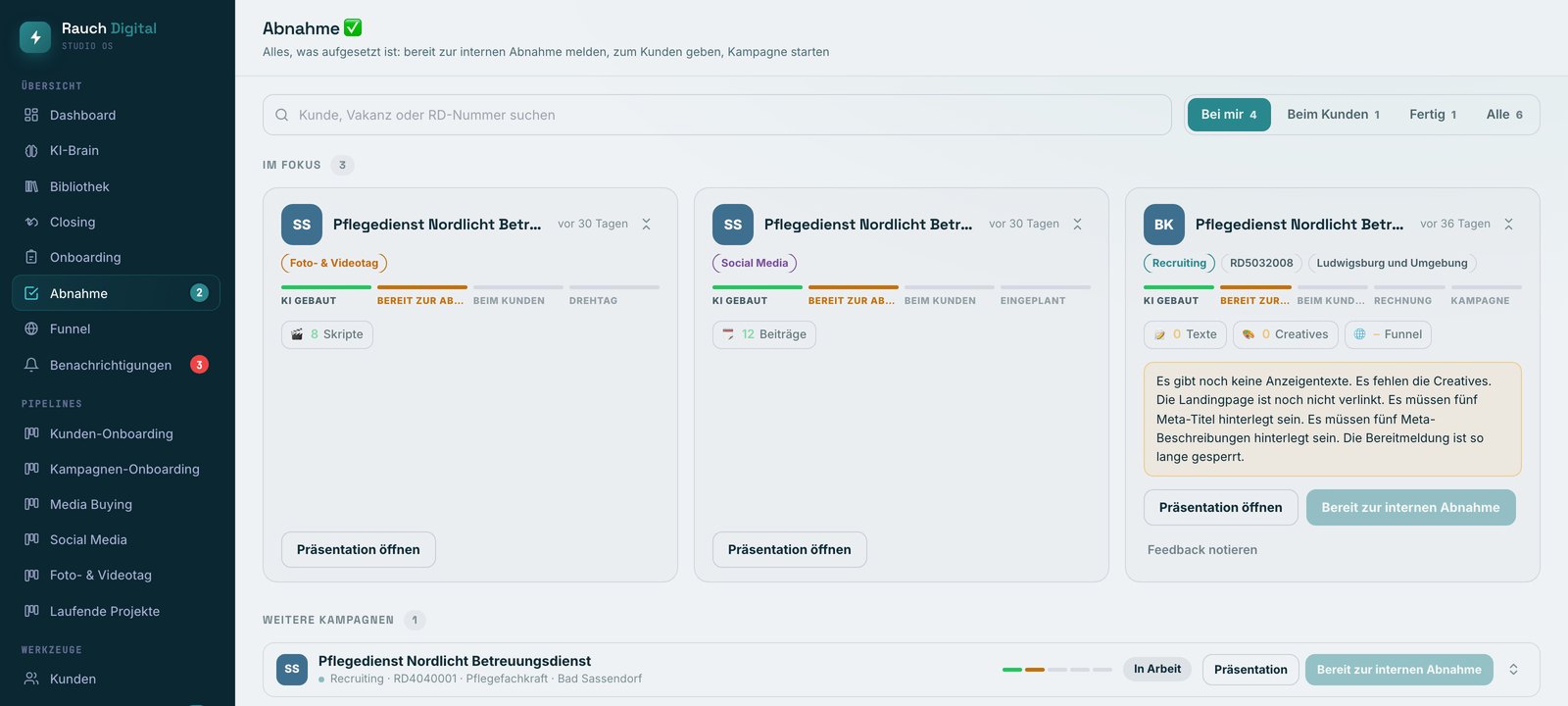
    The agency platform
    Approvals: every campaign with its current stage, from built by AI to campaign live. Client names replaced for this view.
    • Django
    • PostgreSQL
    • React
    • Meta Marketing API
    • Google Ads API
  2. 02

    LeadGate

    The CRM where an application does not sit and wait

    The situation

    A campaign brings applications, but nobody gets hired until someone calls back. Applications landed in the client's inbox. Nobody knew who had already been contacted, and an applicant who hears nothing for two days is gone.

    What I built

    Our own CRM for clients. Every application arrives through a webhook and sits as a card in its campaign's list, with a stage the client moves along. Through the WhatsApp Business integration they write from inside the system instead of copying a phone number into another app.

    What follows from it
    • A dedicated portal per client, a separate applicant list per campaign
    • WhatsApp Business connected, so first contact happens where the application already is
    • The numbers flow back into the agency platform and feed the traffic light, the watchdog and the client report
    • CRM
    • WhatsApp Business API
    • Webhooks
    • REST
  3. 03

    The application funnel

    From the ad to the phone call

    The situation

    The application flows lived with an external vendor. Every page was built by hand, measurement and consent were out of our control, and what a page cost was not something we could steer.

    What I built

    Our own funnels on our own domain, assembled from blocks instead of stored as HTML. Draft and published state are separate. An application goes straight into the CRM, and if that path fails, the platform catches it rather than losing it.

    What follows from it
    • Our own measurement without cookies, IP addresses or sessions: views, drop-off point and time spent per step
    • Conversions API alongside the pixel, both events carrying the same identifier
    • Every funnel passes a check on law, measurement and completeness before the first euro of ad spend
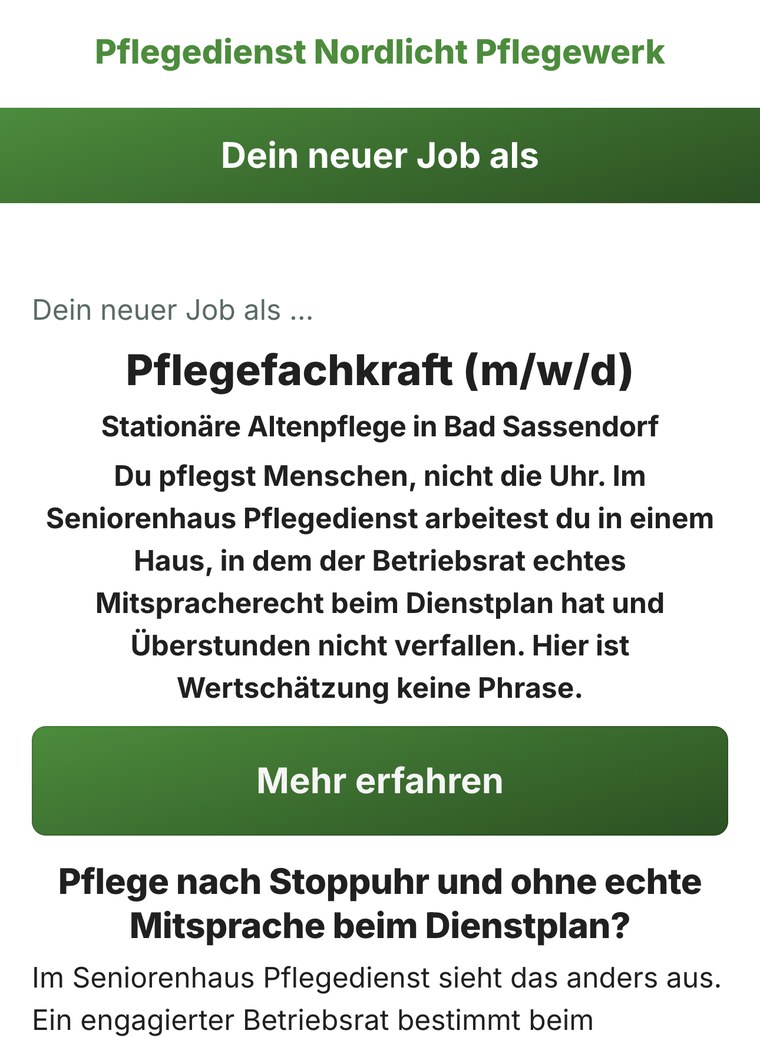
    The application funnel
    The funnel as an applicant sees it on a phone. Client name and branding replaced for this view.
    • React
    • TypeScript
    • Caddy
    • Meta Conversions API
  4. 04

    The knowledge base

    From a folder to an answer

    The situation

    The company's knowledge sat in Google Drive, in the project folder and in people's heads. Anyone who wanted to know how a kickoff runs, or what a contract says, asked a colleague or searched for half an hour.

    What I built

    A searchable store with hybrid retrieval: vectors find what was meant, full text search finds what is literally written. Every chunk carries its own context, so a paragraph from the middle of a contract does not arrive without one.

    What follows from it
    • 3,115 documents in 11,700 chunks, from Drive, the project folder and the platform itself
    • Classified by fixed rules rather than one model call per file, which saves thousands of calls
    • Confidentiality is enforced during the search, not afterwards in the interface
    • pgvector
    • OpenAI embeddings
    • PostgreSQL full text
    • Django

How I got here

  1. 2025to today

    Automation and AI

    Rauch Digital / Witten, Germany

    Responsible for engineering, IT and process automation. I build the platform campaigns are created, approved, launched and billed through.

  2. 2025

    Master's thesis, analytics team

    Ericsson / Stockholm

    Six months in house, working on a real analytics tool. It produced a patent and an application that is still running there.

  3. 2024

    AI for Impact Intern

    AI Sweden / UNICEF Sweden / Stockholm

    A model to identify donors at risk of churning, so UNICEF could follow up where it mattered. Plus a chatbot translating plain language into SQL. Funded by Google.org.

  4. 2017to 2020

    IT business consultant

    BMW Group / Munich

    Cloud computing and agile transformation. Chosen as one of two apprentices for a Udacity nanodegree, Scrum Master (PSM I). Then a QnA chatbot on Azure and Teams that took over onboarding for new apprentices.

The master's thesis turned into a tool that is still in use.

Master's thesis 2025 / Aalto University, in collaboration with Ericsson / Stockholm

  • 300+users a month

    work with it today, well beyond the end of the thesis.

  • 3architectures

    built and measured against each other, not merely described.

  • 1patent

    filed together with my supervisor at Ericsson, and granted.

Patent granted

Multi-agent communication

The work on the agent architectures produced an invention, which I filed together with my supervisor at Ericsson. It was granted.

with Mathew Goonewardena, Ericsson

Bachelor's thesis 2023

Diffusion-Based Data Augmentation for Improving the Classification of EEG Signals

Maastricht University

Health data is scarce precisely because it needs protecting. You cannot collect EEG recordings in arbitrary volume, and without volume no model learns reliably. So I generated synthetic EEG signals with a diffusion model to enlarge the dataset and improve emotion recognition.

Transforming the signal into the frequency domain with an FFT raised classification accuracy by up to 20 percentage points over the same dataset without synthetic data. On identical features, though, a GAN came out ahead on three of the four emotion dimensions. Tested on DEAP, EEG recordings from 32 participants.

  • PyTorch
  • Diffusion
  • GAN
  • DEAP

Studies and academic background

MSc2023 to 2025

ICT Innovation, major in Data Science

KTH Stockholm and Aalto Helsinki

Double degree through EIT Digital. First year at KTH in Sweden, second at Aalto in Finland.

  • Deep learning
  • Computer vision
  • Scalable machine learning
  • Speech processing
  • Data mining
  • Entrepreneurship for engineers
BSc2020 to 2023

Data Science and Artificial Intelligence

Maastricht University

Completed successfully, six semesters taught in English and problem-based. One of them at Reykjavík University in Iceland.

  • NLP
  • Databases
  • Algorithms
  • Mathematical modelling
  • Statistics
  • Linear algebra
Abroad

Reykjavík University, Iceland. Exchange semester during the bachelor's.

Languages

German (native) · English (C2, studied and worked entirely in English)

Certificates
  • Professional Scrum Master I
  • ITIL Foundation Certificate in IT Service Management
  • Udacity Nanodegree

What I work with

Daily
PythonSQLPyTorchDjangoClaude Code
Confident
JavaRMATLABTensorFlowFlaskHadoop
Frontend
TypeScriptReactNext.jsD3Astro

How do you get from an apprenticeship at BMW to building AI systems?

My first contact with artificial intelligence came during the apprenticeship at BMW. What set it off was a Udacity nanodegree I was picked for, one of two apprentices.

Until then I had assumed AI was reserved for great minds. For people like Musk or Zuckerberg, not for me. During the nanodegree it clicked: at the end of the day it is mathematics. And mathematics had always come easily at school.

So I tried it and started studying artificial intelligence. First in Maastricht, then in Stockholm and Helsinki. It worked out.

These days the model interests me less than what comes after it: how it becomes something a team uses every day without thinking about it. That is where my work sits.

since 2019

Growth Library

with my brother Milan

One non-fiction book a week, cut down in a single episode to what actually sticks in daily life. In German, on Spotify, Apple Podcasts and everywhere else.

Listen

Volunteering

Summer camp on Ameland 2014 to 2016

KJG St. Karl Borromäus. Two weeks a year, around 50 children, organising and leading the trip.

Swimming instructor 2013 to 2016

Sport-Union-Annen. Four years teaching children between three and ten how to swim.

Away from the screen

SwimmingBikepackingDivingSkiingRunningReading